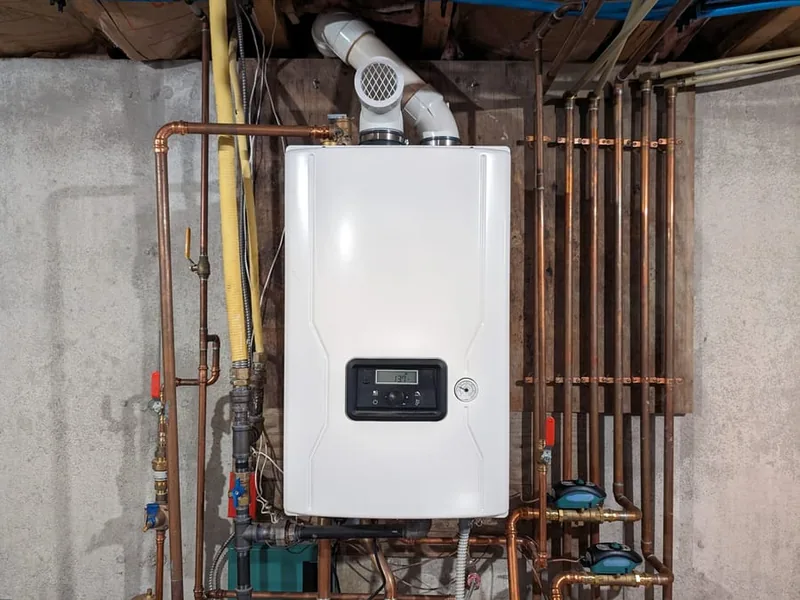
Why Tankless Water Heaters Leak: Causes and What to Do
A puddle under your water heater is never good news, but when the unit is a tankless model, the leak can be trickier to track down. Unlike a traditional tank heater — where a failing tank usually means water weeping from the shell itself — a tankless unit has no storage vessel to rupture. Leaks instead come from connections, internal components, valves, and drainage systems. If you own a tankless water heater in DeSoto, TX and have spotted moisture, dripping, or staining around it, this guide walks you through the most common causes, how to narrow down the source, and when it is time to bring in a professional.
Tankless heaters are popular across North Texas because they deliver endless hot water and tuck neatly onto a garage or exterior wall. But the same compact, high-efficiency design that makes them attractive also means leaks can hide inside the cabinet where you cannot see them. Catching the problem early protects your walls, flooring, and the expensive electronics inside the unit.
How a Tankless Heater Differs (and Why It Matters for Leaks)
A conventional tank heater stores 40 to 50 gallons of hot water around the clock. When its glass-lined steel tank corrodes through, water seeps from the jacket itself — a failure that is usually obvious and usually means replacement. A tankless unit, by contrast, heats water on demand as it flows through a copper or stainless-steel heat exchanger. There is no tank to burst, so the leak sources shift to the parts that handle water under pressure: inlet and outlet fittings, the heat exchanger, the pressure relief valve, the condensate drain (on condensing models), and the internal waterways sealed by gaskets and O-rings.
This matters because many tankless leaks start small and intermittent — a drip that only appears when the burner fires, or a damp spot that dries between uses. Homeowners often assume the unit is "sweating" and ignore it until corrosion or water damage sets in. Learning the real causes below will help you tell a harmless drip from a developing failure. For a broader look at how we track down hidden moisture, see our guide to water heater leak detection methods.
The 7 Most Common Causes of Tankless Leaks
1. Loose or corroded water connections
The most frequent source of tankless leaks is also the simplest: the hot and cold water connections at the bottom of the unit. Over years of thermal cycling — expanding when hot, contracting when cool — threaded fittings can back off slightly. In DeSoto homes with hard water, mineral buildup can also corrode brass and copper fittings from the inside. Look for green or white crust around the connections, a classic sign of a slow weep. Often the fix is as simple as tightening a fitting or replacing a worn washer, but if the threads are corroded, the fitting itself needs replacing.
2. Heat exchanger failure
The heat exchanger is the heart of a tankless unit and its most expensive component. Scale buildup from hard water is its biggest enemy: mineral deposits create hot spots on the copper or stainless tubing, stressing the metal until hairline cracks form. Once the exchanger cracks, water escapes under pressure and the unit must be repaired or replaced — there is no safe patch for a cracked exchanger. In North Texas, where incoming water is notoriously hard, annual descaling (flushing the unit with a vinegar or descaling solution) is the single best defense. If your unit is over ten years old and the leak is coming from inside the cabinet, professional tankless water heater leak repair can confirm whether the exchanger is the culprit.
3. Pressure relief valve discharge
Tankless units have a pressure relief valve just like tank heaters. If it is dripping into its discharge pipe, the valve may be doing its job — releasing excess pressure — or the valve itself may have failed. Common triggers include a faulty expansion tank, excessive incoming water pressure (anything consistently above 80 psi is too high), or overheating. Never cap or plug a relief valve discharge pipe; it is a critical safety device. Our T&P valve replacement service covers testing and replacement when the valve is at fault.
4. Condensate drainage problems
High-efficiency condensing tankless units extract so much heat from exhaust gases that water vapor condenses inside the unit. This condensate is mildly acidic and must drain away through a dedicated line — often routed to a floor drain, utility sink, or an exterior termination. If that line clogs, kinks, or was installed without proper slope, condensate backs up and spills out of the unit, looking exactly like a leak. In winter, exterior condensate lines in Texas can freeze during a hard cold snap (DeSoto homeowners remember February 2021), blocking drainage entirely. Clearing and properly routing the condensate line usually resolves this one.
5. Failed internal gaskets and O-rings
Inside every tankless unit, water passages are sealed by rubber gaskets and O-rings that harden and shrink with age and heat. When a seal fails, water migrates along internal channels and drips from seams or the bottom of the cabinet — often far from the actual failed seal. Because these components sit behind the front cover near the burner and electronics, this is not a DIY repair: water and high-voltage ignition systems do not mix. A technician can pressure-test the unit to isolate the failed seal.
6. Freeze damage
Most tankless units include built-in freeze protection — small electric heaters that keep internal waterways above freezing — but that protection only works when the unit has power. During an extended outage in a Texas cold snap, standing water inside the heat exchanger can freeze, expand, and crack the tubing or the flow sensor housing. Outdoor-mounted units are most vulnerable. If your tankless heater started leaking after a freeze event, suspect a cracked exchanger or split fitting and call for help before firing the unit back up.
7. Improper installation or venting
Tankless units are sensitive to installation details: gas line sizing, vent slope and sealing, and water pressure regulation all matter. A vent pipe with improper slope can let exhaust condensate drip back into the unit. Undersized gas lines cause incomplete combustion and excess condensation. And incoming pressure above the manufacturer's rating stresses every seal in the system. If leaks appeared soon after installation, the install itself deserves a hard look.
How to Pinpoint the Source
Start with the unit off and cool. Dry the area thoroughly with towels, then run hot water at a nearby tap and watch with a flashlight. Note exactly where the first moisture appears — at a fitting, from the relief valve pipe, from inside the cabinet, or from the condensate line termination. Check whether the drip is constant or only occurs while the burner is firing; burner-only drips point toward the heat exchanger or condensate system, while constant drips suggest a fitting or valve. Place a dry paper towel under suspect spots to catch the first drop. Take photos — they help enormously when you describe the problem over the phone.
Ask a Pro → Not sure what you're dealing with? Call (833) 713-2101 and describe what you see — we'll point you in the right direction.
Can You Fix a Tankless Leak Yourself?
Homeowner-safe tasks are limited to the outside of the unit: tightening a visibly loose water connection, clearing a kinked condensate line, and descaling the unit per the manufacturer's instructions. Anything that requires removing the front cover — touching the heat exchanger, gas components, or internal seals — should be left to a trained technician. Tankless units combine water, gas, and electricity in a tight cabinet, and a wrong move can turn a small leak into a dangerous situation or void your warranty. If you are unsure where the water is coming from after the basic checks above, that uncertainty is itself the signal to call.
When to Call a Professional in DeSoto
Call promptly if the leak is coming from inside the cabinet, if water is dripping from the pressure relief valve pipe continuously, if you smell gas, or if the unit shows an error code alongside the moisture. Also call if the leak reappears after you tightened fittings — that means the source is deeper than a loose connection. For leaks that cannot wait, our emergency water heater leak repair team serves DeSoto and nearby Dallas County neighborhoods with same-day response.
Noticed water around your heater? Don't wait for it to get worse. Call (833) 713-2101 → for fast help in DeSoto and the surrounding Dallas County area.
Frequently Asked Questions
Is a small drip from a tankless heater an emergency?
Not always, but treat every drip as worth investigating. A slow weep from a fitting can often wait a day or two; water coming from inside the cabinet or the relief valve deserves same-day attention, since those can escalate or signal a safety device activating.
How long do tankless water heaters last in Texas?
With annual descaling to fight our hard water, 15 to 20 years is realistic — roughly double a tank heater. Without maintenance, scale can kill a heat exchanger in under a decade.
Will descaling stop my tankless leak?
Descaling prevents future damage but cannot repair a crack or failed seal that already exists. Think of it as essential prevention, not a cure.