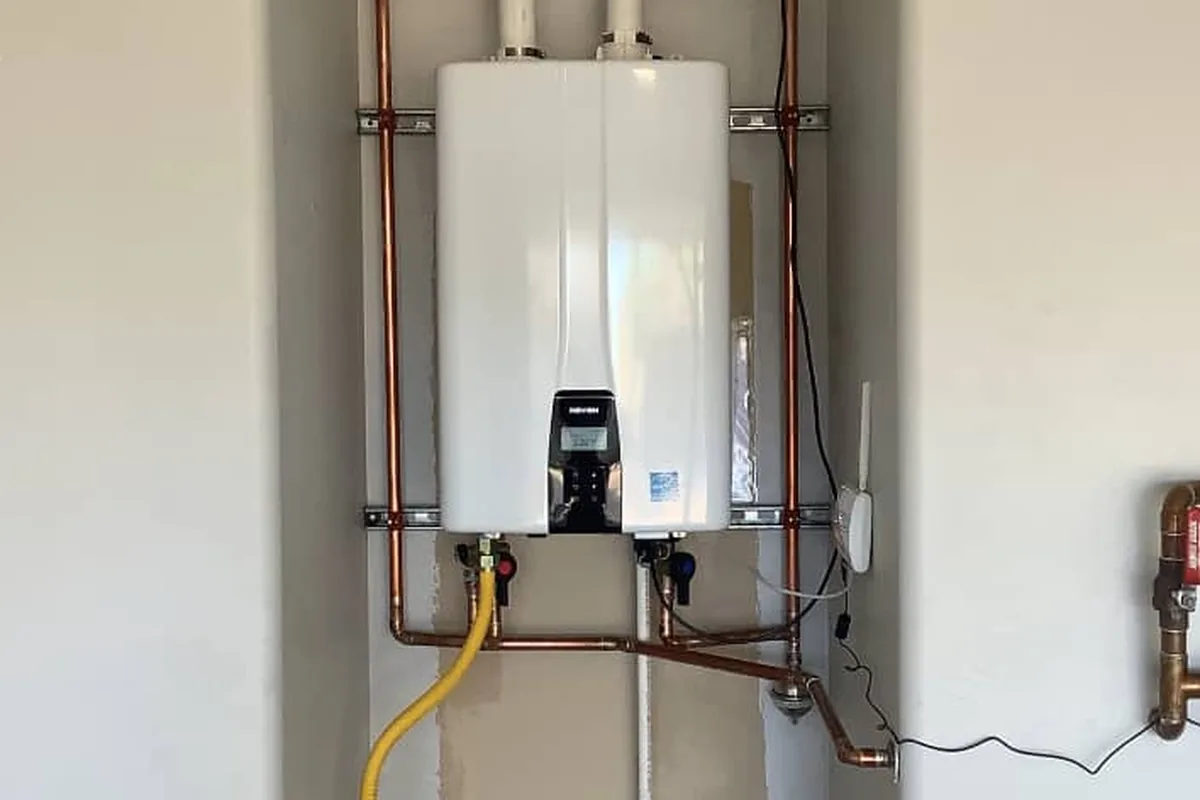
Tankless Water Heater Leak Repair in DeSoto, TX
IN SHORT: A tankless water heater has no tank to burst, so its leaks come from the heat exchanger, water connections, condensate drain, or pressure relief valve. We pinpoint the exact source, repair or replace the failed component, descale the unit, and restore your endless hot water. Call (833) 713-2101 for same-day tankless leak repair anywhere in DeSoto.
A Tankless Leak Is a Different Animal
When a traditional tank water heater leaks, the diagnosis is usually straightforward: the steel tank has rusted through and the whole unit needs replacing. A tankless water heater is a completely different machine, and its leaks behave differently too. There is no big reservoir of water waiting to flood your garage. Instead, water moves through a compact copper or stainless steel heat exchanger only when a hot tap opens, flash-heating as it passes over a powerful gas burner or electric elements. That means a tankless leak is almost always a failed component — a seal, a connection, a section of the heat exchanger, or the condensate system — and in most cases the right fix is a targeted repair, not a whole new unit.
That distinction matters because we see DeSoto homeowners get told their tankless heater is done for when the actual problem is a ten-dollar gasket or a scaled-up heat exchanger that needs a proper flush. Tankless units are precision appliances with serviceable parts: isolation valves, flow sensors, igniters, and heat exchanger assemblies that can be diagnosed individually. Our technicians work on all major tankless brands and models, both condensing and non-condensing, gas and electric, indoor and outdoor installations. We treat your tankless heater like the repairable appliance it is.
Where Tankless Leaks Actually Come From
Finding a tankless leak starts with knowing where to look. These are the failure points we check, in the order we check them:
The heat exchanger
This is the heart of the unit — a winding coil of copper or stainless tubing where cold water absorbs heat from the burner. Pinhole leaks develop here when mineral scale bakes onto the inside of the tubing. The scale creates hot spots where the metal overheats, weakens, and eventually weeps or sprays. On condensing units, the secondary stainless heat exchanger can also develop leaks at its welded joints. Heat exchanger leaks often show up as water dripping from inside the cabinet or steam and sizzling sounds during operation.
Water inlet and outlet connections
The cold-water-in and hot-water-out fittings at the bottom of the unit take constant pressure and thermal cycling. We frequently find leaks at threaded connections, union fittings, and the rubber washers inside them — especially on units where the installer skipped dielectric unions or overtightened a fitting years ago. These leaks are usually steady drips that leave mineral trails down the pipes.
Isolation and service valves
Tankless units should have hot and cold isolation valves with service ports for flushing. The packing nuts on these valves loosen over time, and the small service-port caps can weep. A valve that was never fully closed after the last flush is another classic source of a slow drip.
The condensate drain (condensing units)
High-efficiency condensing tankless heaters squeeze extra heat from exhaust gases, which produces acidic condensate — roughly a gallon or more per hour of operation. That condensate drains through a small trap and line to a drain or neutralizer. If the trap clogs, the line kinks, or the neutralizer media is spent, condensate backs up and spills out of the cabinet. Many homeowners mistake this for a water leak, but it is a drainage problem with a straightforward fix.
The pressure relief valve
Tankless units carry a pressure relief valve just like tank heaters. If it drips, the cause is usually thermal expansion in a closed plumbing system or incoming pressure running too high — not a bad valve, though valves do fail. We test the valve and check your system pressure before replacing anything.
Freeze damage
Outdoor tankless units and units in unconditioned garages rely on small internal freeze-protection heaters that only work when the unit has power. During an extended outage in a hard freeze, the heat exchanger can split. We saw this across North Texas after the February 2021 freeze, and we still repair freeze-split exchangers on DeSoto homes every winter.
How We Track Down and Fix Your Tankless Leak
- Safe shutdown and visual inspection. We cut power and gas, then open the cabinet and trace every water path with the unit both off and running. Most leaks reveal themselves once you know the failure map above.
- Pressurize and isolate. We close the isolation valves to separate the unit from your house plumbing, then watch whether the leak continues. This tells us in minutes whether the problem is inside the heater or in the connected piping.
- Component-level diagnosis. We check the heat exchanger with a flashlight and mirror for pinholes and mineral weeping, test the relief valve, inspect the condensate trap and neutralizer, and examine every fitting and valve for failed seals.
- Targeted repair. Failed gaskets, washers, valves, and fittings get replaced with manufacturer-spec parts. Pinhole heat exchanger leaks are evaluated honestly — small, accessible ones can sometimes be repaired, but a widely scaled exchanger usually earns a replacement heat exchanger or, on older units, a new heater.
- Descale flush. Because scale caused or contributed to most tankless leaks we see in DeSoto, we circulate a descaling solution through the unit to dissolve mineral buildup, restoring heat transfer and protecting the repair.
- Test fire and verify. We restore power and gas, run hot water at multiple fixtures, confirm no drips under pressure and temperature, and check that error codes are clear and the unit modulates properly.
Warning Signs Your Tankless Unit Is Leaking
- Water pooling beneath the unit or staining on the wall behind it
- Error codes on the display, especially ignition or overheating faults that appear alongside moisture
- A sizzling or hissing sound from inside the cabinet while the burner fires
- White or green mineral crust forming on pipes, valves, or the bottom of the cabinet
- Hot water that cuts in and out, or flow that seems lower than it used to be
- A musty smell in the garage or utility closet where the unit hangs
- The condensate line dripping constantly, even long after hot water use stops
- Rust-colored water from hot taps, hinting at corrosion inside the exchanger or fittings
If you notice any of these, shut off the water to the unit with the cold isolation valve and give us a call at (833) 713-2101. Running a leaking tankless heater can turn a small seal failure into a ruined circuit board, and electronics are the expensive part.
DeSoto's Hard Water Is Brutal on Tankless Heat Exchangers
DeSoto's drinking water comes from the City of Dallas system, drawn from area lakes and reservoirs. Utility reports put local hardness around 7 to 8 grains per gallon, solidly in hard-water territory, and it spikes higher at times. For a tankless heater, that mineral load is the number one enemy. Every gallon that flashes through the heat exchanger leaves a trace of calcium behind, and at the 140-plus-degree surface temperatures inside the coil, that trace bakes into rock-hard scale fast.
Scale does two kinds of damage. First, it insulates the tubing so the burner has to fire hotter and longer to deliver the same hot water, which drives up gas bills and stresses the unit. Second, it creates localized hot spots where the copper overheats and weakens — the direct cause of most pinhole exchanger leaks we repair in DeSoto. This is why manufacturers recommend descaling tankless units annually in hard-water areas, and why we bundle a flush with nearly every tankless leak repair we do here.
Local housing stock plays a role too. Much of DeSoto was built out from the 1960s through the 1980s, and many of those homes still run on their original galvanized or early copper supply lines. Corrosion debris from aging pipes migrates straight into the tankless inlet filter and heat exchanger, compounding the scale problem. We clean the inlet screen and check your water pressure as part of every service call, because a tankless unit fed by gritty, high-pressure water will keep coming back with new leaks until the underlying conditions are addressed.
Repair It or Replace It? An Honest Answer
Most tankless leaks are worth repairing. Fittings, valves, seals, sensors, and condensate components are all replaceable at a fraction of the cost of a new unit, and a quality tankless heater is designed for a 15- to 20-year service life. We lean toward replacement only when the heat exchanger itself is extensively compromised on a unit that is already past its prime, or when repair costs approach half the price of a new high-efficiency model. We will show you exactly what failed, explain your options in plain language, and let you decide — no pressure, no scare tactics. If repair is the smart move, we repair. If your money is better spent on a new unit, we will tell you that too.
Tankless Leak Questions DeSoto Homeowners Ask Us
Can a leaking heat exchanger be repaired, or does it need replacing?
It depends on the extent of the damage. A single accessible pinhole on an otherwise healthy exchanger can sometimes be repaired, but widespread scaling with multiple weep points means the metal is compromised throughout, and a replacement heat exchanger — or a new unit on an older heater — is the reliable fix. We inspect and give you a straight assessment before quoting anything.
Why does my tankless heater only leak when hot water is running?
Because water only flows through the heat exchanger on demand. A pinhole or cracked fitting inside the water path stays dry until flow and pressure arrive, then it weeps or sprays. Leaks that appear only during operation point squarely at the exchanger or its connections rather than the condensate system.
Is water dripping from the condensate line normal?
Some condensate drainage during and shortly after operation is normal on a condensing unit — that is the system working as designed. Constant dripping, puddling inside the cabinet, or condensate appearing where it should not are not normal and deserve a service call.
How often should a tankless unit be descaled in DeSoto?
At least once a year given local water hardness, and every six months if your household uses a lot of hot water or you have no water softener. Regular descaling is the single best defense against the scale-driven pinhole leaks we repair most often.
My unit shows an error code and there is water underneath. Are they related?
Very often, yes. Water dripping onto the igniter, flame sensor, or control board causes ignition failures and sensor faults. Fix the leak first, then confirm the electronics survived — which is another reason not to keep running a leaking unit.
Do you service outdoor tankless installations?
Yes. Outdoor units are common in DeSoto, and we repair their leaks, verify freeze-protection operation, and check that recess boxes and vent terminations are draining properly instead of funneling rainwater into the cabinet.
Stop That Tankless Drip Before It Becomes a Flood
A small tankless leak never fixes itself — it migrates to the electronics and turns a simple repair into a replacement. Our DeSoto technicians diagnose the exact failed component, fix it right, and descale your unit so it stays fixed. Call (833) 713-2101 now for same-day tankless water heater leak repair in DeSoto, TX.