Water Heater Leak Detection in DeSoto, TX
IN SHORT: Not every puddle under a water heater means the tank has failed — fittings, valves, condensation, and drain lines are frequent culprits. Our leak detection service pinpoints the exact source using systematic testing and professional instruments, so you repair what is actually broken. Call (833) 713-2101 for expert water heater leak detection in DeSoto.
Before You Replace a Water Heater, Find Out What Is Actually Leaking
Water on the floor around a water heater triggers a natural panic: the tank must be rusting through, the garage is about to flood, and a full replacement is unavoidable. Sometimes that is exactly what is happening. But in our experience across DeSoto homes, a large share of water heater leak calls trace back to something far less dramatic — a weeping supply fitting, a drain valve that never fully closed, a TPR valve bleeding off pressure, or plain condensation dripping off cold pipes in a humid Texas garage. Each of those has a targeted, affordable fix. The difference between a fifty-dollar repair and a full heater replacement often comes down to one thing: an accurate diagnosis before anyone starts wrenching.
That is what professional leak detection is. Not a glance and a guess, but a methodical process of elimination that identifies the precise point of failure — or proves the tank itself has failed, so you can replace it with confidence instead of suspicion. We bring moisture meters, thermal imaging, and pressure-testing equipment, but the most valuable tool is the procedure: dry everything, watch systematically, and let the water reveal its own path.
Leak or Condensation? The First Question We Answer
DeSoto summers are long, hot, and humid, and many water heaters sit in unconditioned garages. Cold water entering the tank chills the tank wall and the first few feet of supply piping well below the dew point of that humid garage air. The result is condensation — beads of moisture that form on the tank, run down, and pool at the base, looking exactly like a leak. We see this constantly from May through September.
Condensation has telltale signatures: it appears heaviest when the tank is recovering after heavy hot-water use, it forms on cold supply pipes as well as the tank, and it vanishes in cooler, drier weather. A true leak persists regardless of humidity and leaves mineral trails or rust staining at its source. We verify which one you have before recommending anything, because selling a new heater to fix summertime condensation would be dishonest — the real answer is often insulation on the pipes and better garage ventilation.
The Usual Suspects: Where Water Heater Leaks Start
When the water is real, we work through the failure points in order of likelihood:
Supply fittings and dielectric unions
The hot and cold connections at the top of the tank see constant pressure and thermal movement. Dielectric unions — the fittings that join copper house piping to the steel tank nipples — corrode internally over time, and their rubber washers harden and weep. Drips here run down the tank side and pool at the base, mimicking a tank failure perfectly.
The drain valve
The small spigot near the tank bottom is used for flushing sediment. Plastic drain valves crack with age, and brass ones develop washer failures. A valve that was opened for a flush and never seated perfectly can seep for months. Because it sits at the lowest point of the tank, its drips are easy to mistake for a bottom-seam tank leak.
The TPR valve and its discharge pipe
A relief valve bleeding off thermal expansion or high pressure drips through its discharge pipe to the floor. Homeowners see water at the base of the heater and assume the worst, when the actual problem is system pressure — a very different repair.
The anode rod port
The hex head on top of the tank where the sacrificial anode rod threads in can weep around its seal, especially after a rod replacement where the threads were not sealed properly. Slow, intermittent, and often misdiagnosed.
The tank itself
When the steel tank rusts through — usually at the bottom seam, around welded fittings, or behind heavy sediment — the leak is terminal. Tank leaks do not stop, do not slow, and cannot be patched reliably. Rust-colored water, a leak that grows week by week, and moisture with no fitting anywhere nearby are the classic signs.
How We Pinpoint the Source
- History and visual survey. We ask when the water appears, whether it correlates with hot-water use or weather, and how long it has been happening. Then we inspect the full installation: fittings, valves, pan, discharge piping, and the surrounding floor and walls for staining patterns.
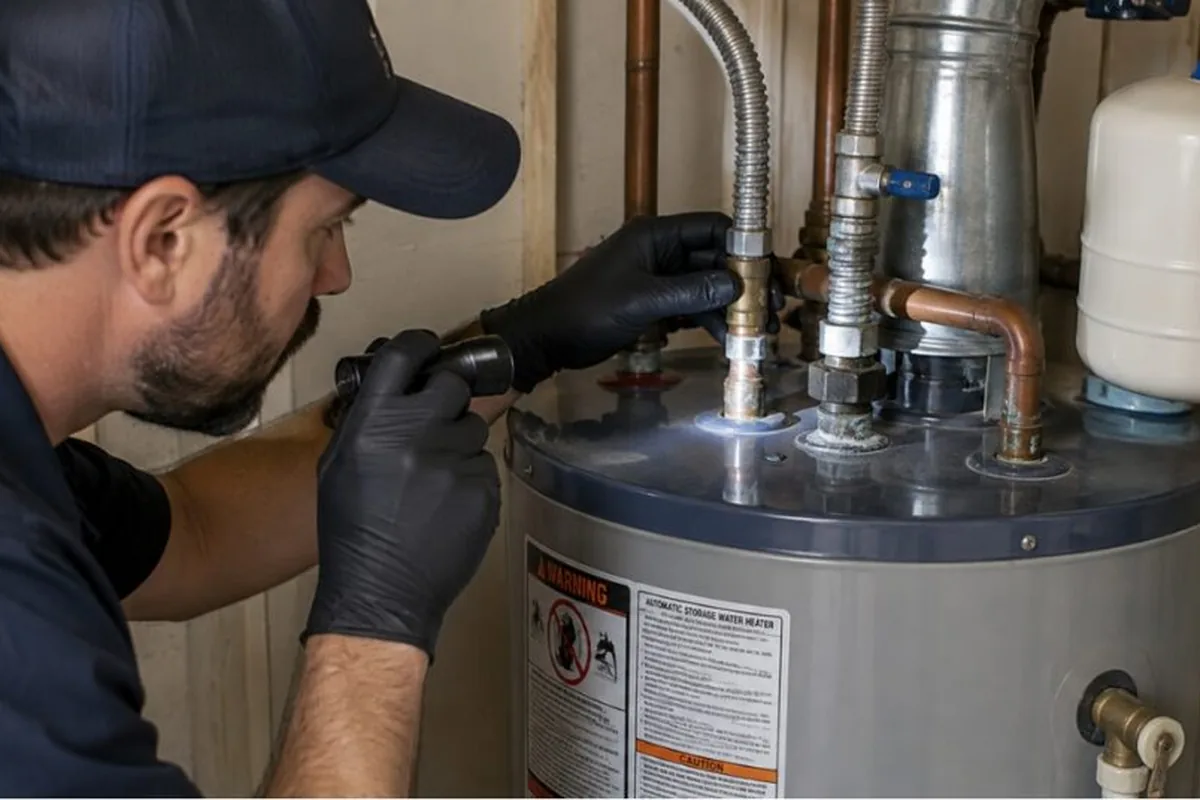
- Dry and watch. We dry every surface completely — tank, pipes, fittings, floor — then run the heater through a full cycle while watching with a flashlight. Fresh water against dry metal betrays its origin quickly.
- The paper-towel method. Low-tech and decisive: dry paper towels wrapped around each suspect fitting show exactly which joint is weeping, even when the drip is too slow to see.
- Moisture meter and thermal imaging. Pin-type meters confirm whether damp drywall or flooring is active moisture, and a thermal camera reveals cold-water tracks inside walls and under slabs that eyes cannot see — essential when a leak has migrated away from the heater.
- Pressure isolation. We valve off the heater from the house plumbing and watch the system pressure. If the leak stops, the source is in the connected piping or fixtures; if it continues, it is inside the heater assembly. Then we isolate further — supply side versus tank — until one component stands alone.
- Written findings and options. You get a plain-language report: what is leaking, why it is leaking, what it will take to fix, and — when the tank has failed — honest replacement options with no obligation.
Attic Installations: DeSoto's Hidden Leak Risk
Many two-story DeSoto homes hide the water heater in the attic to free up garage space. An attic leak does not puddle on concrete where you will notice it — it soaks insulation, stains ceilings, and can collapse drywall before anyone looks up. If your heater is in the attic, leak detection takes on real urgency, and we treat these calls as priority. We check the drain pan and its drain line (often clogged or never connected to the exterior), scan the ceiling below with thermal imaging for hidden saturation, and recommend pan alarms or automatic shutoff valves that catch the next leak at the first drop. An attic heater without a working pan drain is a ceiling replacement waiting to happen.
What Happens After We Find It
Detection is only half the value — the other half is that most of what we find is repairable. Failed fittings get new dielectric unions and washers. Drain valves get replaced with full-port brass valves that will outlast the tank. TPR valve drips get traced to their pressure cause and fixed at the source. Condensation gets insulation and ventilation advice instead of a parts bill. And when the diagnosis is a failed tank, you will know it with certainty — we will show you the rust, the weep point, and the staining — so the replacement decision is yours, made with facts.
We carry common repair parts on the truck, which means most fitting, valve, and seal repairs are completed in the same visit as the detection. If replacement is the answer, we can usually install the new heater the same day or the next, including the drain pan, expansion tank, and code-compliant discharge piping your installation should have.
The DeSoto Conditions That Cause Leaks
Local water and housing patterns shape what we find. DeSoto's Dallas-supplied water runs moderately hard, around 7 to 8 grains per gallon, and sediment accumulates fast in tanks that are never flushed. That sediment does more than reduce efficiency — it creates hot spots on the tank bottom that accelerate corrosion from the inside, and it buries the lower portions of the tank where leaks start unseen. Heaters in DeSoto that go five-plus years without a flush are prime candidates for premature tank failure.
The housing stock compounds it. Big sections of DeSoto were built from the 1960s through the 1980s, and original-era galvanized supply lines are still in service in many of those homes. Galvanized pipe sheds rust and scale into the heater, grinding away at valves and fittings and seeding the corrosion that eventually breaches the tank. When we detect a leak in an older DeSoto home, we always assess the supply piping too — fixing the heater while ignoring disintegrating galvanized lines just schedules the next leak.
And then there is the February 2021 freeze, which taught North Texas a lasting lesson. Pipes and fittings weakened by freeze expansion can develop slow leaks months or years later as the stressed joints finally give way. If your heater's supply lines or valves survived 2021 but are now weeping, freeze-weakened joints are a likely culprit, and we know exactly where to look.
Leak Detection Questions DeSoto Homeowners Ask Us
How can you tell if the tank itself is leaking versus a fitting?
By eliminating everything else. We dry the tank completely, wrap every fitting, and watch through a full heating cycle. If water appears on bare tank steel with every connection proven dry — especially with rust staining or mineral trails originating at a seam — the tank has failed. It is a diagnosis of exclusion, done carefully.
There is water but I never see an active drip. Why?
Slow leaks evaporate between appearances, especially in a hot garage. Intermittent sources like TPR valve discharges during heating cycles or condensation during recovery leave water with no visible drip when you check. Our dry-and-watch method through a full cycle catches what casual inspection misses.
Can a leaking water heater be repaired, or must it be replaced?
Fittings, valves, seals, and supply connections can all be repaired — only a breached steel tank itself cannot. Roughly speaking, if the leak is at anything attached to the tank, it is repairable; if it is coming through the tank wall, the heater needs replacement.
Do you use cameras or special equipment?
Yes — thermal imaging cameras to trace hidden moisture, pin-type moisture meters to confirm active dampness in surrounding materials, and pressure gauges for isolation testing. The instruments confirm what the systematic visual process finds.
How fast can you come out?
Active leaks get same-day priority, and attic installations jump the queue because of the ceiling-damage risk. Call (833) 713-2101 and tell us what you are seeing — we will triage it on the phone.
Will detection cost me extra if I need a replacement anyway?
No. When detection leads to a replacement we perform, the diagnostic work is part of the job — you are paying for the solution, not paying twice. We will explain exactly how the pricing works before we start.
Find the Leak Before It Finds Your Floor
Guessing at a water heater leak wastes money in both directions — replacing a heater that needed a washer, or patching fittings on a tank that is done. Our DeSoto technicians find the exact source and fix what is actually broken. Call (833) 713-2101 now for professional water heater leak detection in DeSoto, TX.