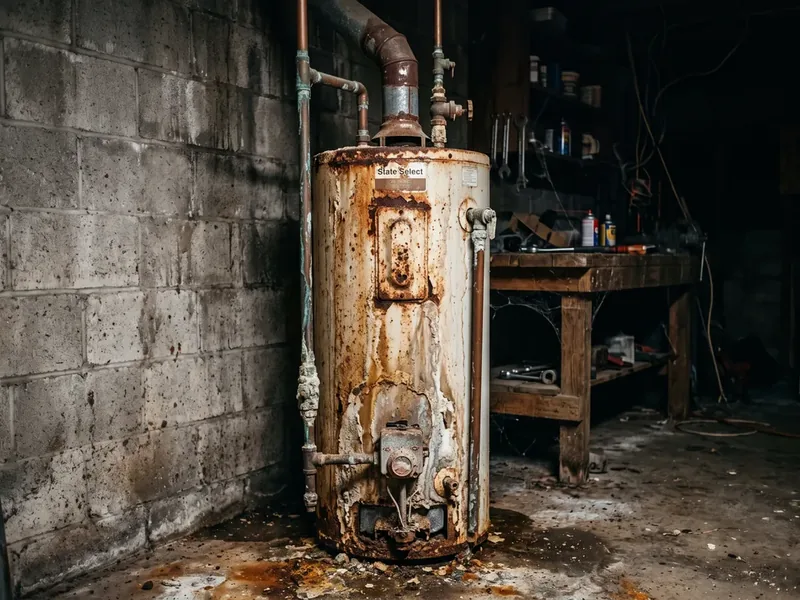
Water Heater Lifespan: How Long Yours Should Last
Every water heater has an expiration date — the question is whether yours is approaching quietly or announcing itself with a leak at 2 a.m. Knowing the realistic lifespan of your unit helps you plan a replacement on your schedule instead of reacting to a failure on the heater's schedule. In DeSoto, TX, local conditions like hard water and hot garage installations nudge those numbers around, so this guide covers standard lifespans for tank and tankless units, the factors that shorten or extend service life in North Texas, the warning signs of a dying heater, and how to squeeze the maximum years out of the one you have.
Standard Lifespans: Tank vs. Tankless
- Conventional tank (gas or electric): 8 to 12 years. Most manufacturers warranty tanks for 6 years, with 9- and 12-year models built with larger anode rods or thicker glass lining. In practice, a well-maintained tank in DeSoto reaches 10 to 12 years; a neglected one in hard water can fail at 7 or 8.
- Tankless (gas or electric): 15 to 20+ years. With no stored water constantly attacking a steel tank, tankless units last roughly twice as long — provided they get annual descaling. Without it, North Texas hard water can destroy a heat exchanger in under a decade.
- Heat pump (hybrid) water heaters: 10 to 15 years. Growing in popularity for their efficiency, with lifespans between tank and tankless.
Check your unit's age right now: the serial number on the rating plate usually encodes the manufacture date (most brands use a letter-for-month, numbers-for-year scheme, or a plain date stamp). If you cannot decode it, a quick photo sent to the manufacturer or your technician settles it. Age is the single most useful fact in every repair-vs-replace decision — see our replacement vs. repair guide for how we use it.
What Shortens Water Heater Life in DeSoto
Hard water and sediment
Dallas County water is moderately to very hard, and hardness is the number one lifespan killer. Dissolved calcium and magnesium precipitate out as sediment that blankets the bottom of a tank heater, forcing the burner or elements to overheat the steel to push heat through the insulating layer. That overheating stresses the glass lining and the tank steel, while the sediment itself harbors corrosive conditions against the tank bottom. In tankless units, the same minerals plate onto the heat exchanger as scale, creating hot spots that crack tubing. Annual flushing (tank) or descaling (tankless) is the direct countermeasure.
Neglected anode rod
The anode rod is a sacrificial magnesium or aluminum rod that corrodes so the steel tank does not have to. Once it is consumed — typically in 3 to 5 years in hard water — the tank itself becomes the anode, and corrosion accelerates dramatically. Most homeowners never check the rod, which is why so many tanks die "suddenly" at year nine. Replacing a depleted rod can add years to a tank's life; our anode rod replacement service covers inspection and swap.
Excessive pressure and temperature
Water pressure consistently above 80 psi and temperature settings above 120°F both age a heater faster — pressure stresses seams and valves, heat accelerates corrosion chemistry and sediment baking. A ten-dollar gauge on a hose bib and a thermometer at the tap tell you where you stand.
Installation environment
DeSoto garages can top 110°F in August. That heat does not directly kill heaters, but attic installations do suffer: poor ventilation bakes controls and wiring, and a leak in an attic goes unnoticed far longer, turning a small failure into structural damage. Wherever the unit sits, it needs clearance, airflow, and a visible drain pan.
7 Signs Your Water Heater Is Near the End
- Age past the expectancy window. A 12-year-old tank or 20-year-old tankless owes you nothing; budget for replacement even if it still runs.
- Rusty or discolored hot water. Clear cold water but rusty hot water means the tank's interior — or the anode rod's last remains — is corroding.
- Rumbling and popping that flushing does not fix. Hardened sediment that survives flushing keeps overheating the tank bottom.
- Moisture or rust around the base. Weeping seams or a damp tank bottom signal the steel is failing. Review our leak detection methods to confirm the source before deciding.
- Frequent repairs. Two service calls in two years on an old unit is a pattern, not bad luck.
- Inconsistent temperature or slow recovery. Failing elements, heavy sediment, or a dying gas control all show up as the heater struggling to keep up.
- Rising energy bills. A sediment-choked heater works harder for the same hot water; the utility bill often rises months before the failure.
Ask a Pro → Not sure what you're dealing with? Call (833) 713-2101 and describe what you see — we'll point you in the right direction.
How to Maximize Your Heater's Lifespan
- Flush sediment annually (tank) or descale annually (tankless). In DeSoto's hard water, this is the highest-value maintenance there is.
- Check the anode rod every 2 to 3 years and replace when depleted.
- Keep temperature at 120°F — hot enough for comfort and dishwashing, cool enough to slow corrosion and scalding risk.
- Test the T&P valve yearly and replace it every 4 to 6 years so pressure events never become tank events.
- Verify water pressure is 40 to 80 psi and install an expansion tank if your plumbing is a closed system.
- Keep the area clear and the pan drained so small issues stay visible instead of hidden.
Our full water heater maintenance checklist turns this list into a seasonal routine you can follow in under an hour a year.
Planning Replacement Before Failure
The cheapest water heater replacement is the one you plan. A planned swap lets you compare efficiency ratings, choose the right size for your household, schedule the work on a weekday, and handle code upgrades — pan, drain line, expansion tank — without emergency pricing. An unplanned replacement at 10 p.m. with water spreading across the garage costs more and chooses for you. If your unit is within two years of its expectancy window, start the conversation now: our replacement specialists will assess your current unit honestly and tell you whether you have years left or are running on borrowed time.
Noticed water around your heater? Don't wait for it to get worse. Call (833) 713-2101 → for fast help in DeSoto and the surrounding Dallas County area.
Frequently Asked Questions
Can a water heater last 20 years?
Tankless units routinely do with maintenance. Tank heaters occasionally reach 15+ years with soft water and diligent anode rod replacement, but in DeSoto's hard water that is the exception, not the rule.
Does a longer warranty mean a longer-lasting heater?
Mostly it means a bigger anode rod and thicker glass lining from the factory — which genuinely helps. But no warranty survives neglect: an unflushed 12-year-warranty tank in hard water can still fail at year eight.
Should I replace my heater preventively at year 10?
Not automatically — get it inspected first. If the anode rod has been maintained, pressure is normal, and there are no signs from the list above, many tanks serve reliably to year 12. Preventive replacement makes sense when the unit shows multiple warning signs or a failure would cause major damage (attic installations, finished basements).