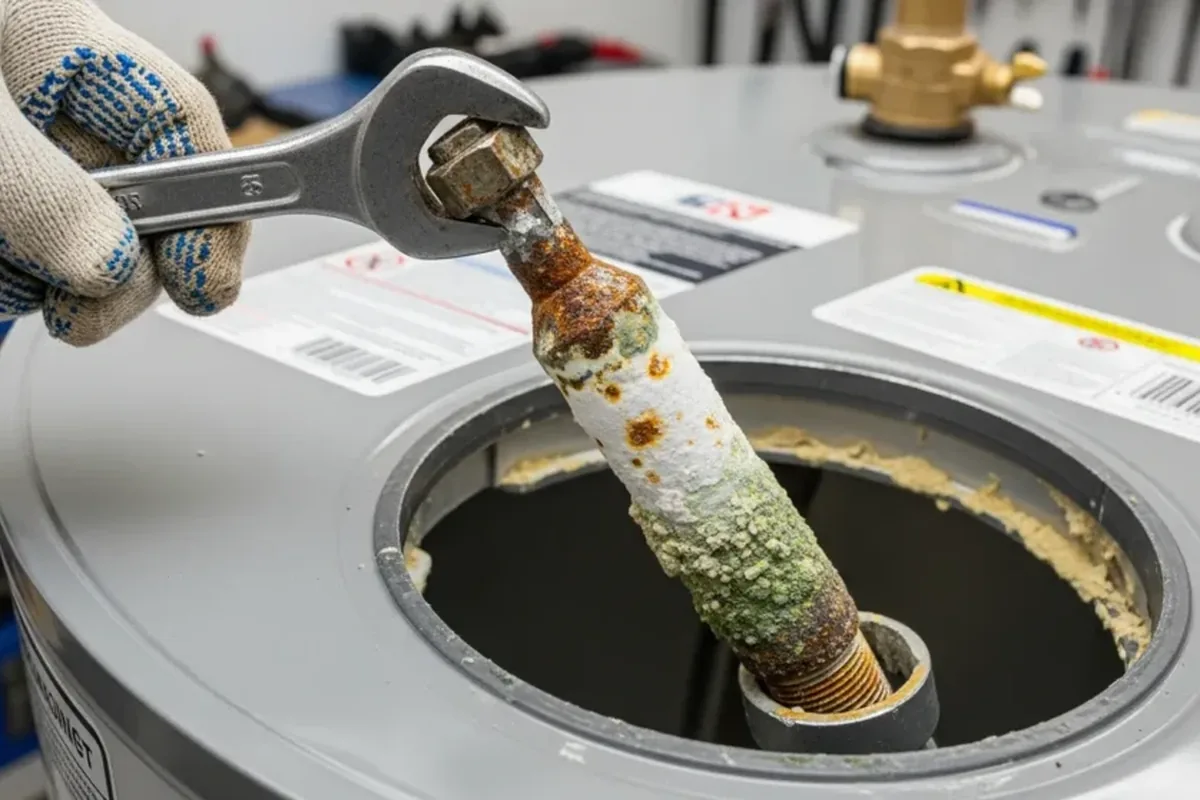
IN SHORT: Your anode rod is a sacrificial metal core that corrodes so your steel tank does not. In DeSoto's mineral-rich water, a rod dissolves in three to five years, and once it is gone the tank starts rusting itself. Replacing the anode on schedule can add years to a water heater's life for a fraction of replacement cost.
Most water heater tanks are made of steel, and steel plus hot water equals rust. Manufacturers slow that chemistry down with a glass lining, but the lining always has microscopic gaps, and hot water finds every one of them. That is why every tank-style heater ships with an anode rod: a magnesium or aluminum rod, usually about three to four feet long, threaded into the top of the tank. It is deliberately made of a metal that corrodes more easily than steel. As long as the rod has metal left to give, it sacrifices itself and the tank stays whole. When the rod is gone, the tank becomes the sacrificial metal, and the clock starts ticking toward a leak.
The frustrating part is that nobody sees the rod. It hides under a hex-head plug on top of the heater, doing its job silently for years. Homeowners in DeSoto usually learn about it in one of two ways: a plumber mentions it during a service call, or the tank fails years earlier than expected. This page explains what the rod does, how to tell when it is spent, how a professional replacement works, and why DeSoto's water chemistry makes this small part matter more here than in many other cities.
How Sacrificial Protection Actually Works Inside Your Tank
Put two different metals in water and connect them, and you have built a battery. One metal gives up electrons and corrodes; the other is protected. Inside your water heater, the steel tank and the anode rod form exactly that kind of galvanic cell, with hot water as the electrolyte. The rod's metal sits higher on the galvanic scale, meaning it is more reactive, so corrosion attacks the rod first and leaves the steel alone.
You can see the evidence when an old rod comes out. A fresh rod is a smooth, solid bar about three-quarters of an inch thick. A spent one looks chewed: pitted, narrowed to a wire in places, sometimes with the steel core wire exposed along its length. That eaten-away metal is corrosion that would otherwise have been eating your tank wall. The process never stops while water is in the tank, which is why the rod is a consumable with a lifespan, not a permanent part.
Magnesium, Aluminum-Zinc, or Powered: Picking the Right Rod for DeSoto
Not all anode rods are the same, and the right choice depends on your water. Magnesium rods offer the strongest protection and are the default in many new heaters, but they react more aggressively with sulfate-reducing bacteria, which can intensify the rotten-egg smell some homeowners notice in hot water. Aluminum-zinc rods corrode a little more slowly and are far less likely to feed that sulfur smell, which makes them a common recommendation in North Texas where mineral content runs high. Powered (impressed-current) anodes are a different animal entirely: a titanium rod driven by a small electrical current that never dissolves, so it never needs replacing, though it does need a nearby outlet.
For most DeSoto homes we recommend aluminum-zinc as the replacement, because it balances protection with odor control in our water conditions. If your household already fights a sulfur smell in hot water, a powered anode is often the better long-term answer. We carry all three types and choose based on what we find in your tank and what your water is doing.
How We Replace an Anode Rod, Step by Step
- Assess the heater first. We check the unit's age, look at the condition of top fittings, and measure the clearance above the heater. Many DeSoto garage installations have low ceilings or shelving overhead, so we note whether a standard rigid rod will fit or a segmented flexible rod is needed.
- Make the heater safe. Electric units get switched off at the breaker; gas units get turned to pilot or off. Then we open a hot-water tap somewhere in the house to relieve pressure.
- Drain down a few gallons. The rod sits at the very top of the tank, so we only need to drop the water level a few inches below the port, not empty the tank.
- Break the old rod free. Years of heat cycles seize the hex head in place. We use an impact wrench and, when needed, a breaker bar, bracing the tank so torque does not twist the plumbing.
- Extract and inspect. The old rod comes out slowly to avoid scraping the tank interior. We measure what is left of its diameter and show it to you, so you can see exactly how much protection remained.
- Install the new rod. Threads get PTFE tape and pipe thread sealant, the rod goes in straight to avoid cross-threading, and it is torqued to a firm seal without over-tightening.
- Refill, purge air, and verify. We close the drain, refill the tank completely, bleed air from the hot taps until water runs solid, then restore power or relight the pilot and check the port for any weeping.
Signs the Anode in Your DeSoto Heater Is Spent
- Rotten-egg smell in hot water only. Cold water smells fine, hot water smells like sulfur. That points to bacteria reacting with a magnesium anode, a classic sign the rod chemistry needs attention.
- Rusty or discolored hot water. When the rod is gone, the tank wall starts contributing iron to your hot water. If the cold runs clear and the hot runs tinted, the tank is corroding from the inside.
- The heater is four or more years old with no rod service on record. In DeSoto water, that is past the point where a first inspection is overdue.
- Rumbling or popping from the tank. Heavy sediment plus a depleted rod often travel together, and both shorten tank life.
- Visible corrosion on top nipples or the old rod port. What you can see on the outside hints at what is happening on the inside.
- A previous rod came out as a bare wire. If the last replacement revealed a rod eaten to its core, the replacement interval for your water is on the short side.
Why DeSoto Water Eats Anode Rods Faster Than Average
DeSoto draws its municipal supply from the same North Texas surface-water system that serves the Dallas area, and that water carries a meaningful load of dissolved minerals. Hard, mineral-rich water is a more aggressive electrolyte, which speeds the galvanic reaction that consumes the rod. Add DeSoto's long, hot summers, where garage-installed heaters bake in triple-digit ambient heat and inlet water arrives warm, and the chemistry runs faster still: heat accelerates corrosion the same way it accelerates almost every chemical reaction.
Two more local factors matter. First, many DeSoto neighborhoods were built out in the 1970s through the 1990s, and a surprising number of those homes still run heaters that have never had a rod inspection, meaning the original rod failed years ago and the tank has been unprotected ever since. Second, homes with water softeners, common here as a response to hard water, actually deplete anode rods faster, because softened water is more conductive and more aggressive toward the rod metal. If you have a softener, your rod interval shrinks, not grows.
What Else We Inspect While the Tank Is Open
An anode replacement puts a technician hands-on with the top of your tank, and we treat it as a mini health check at no extra charge. We look at the dip tube for cracking, test the temperature-and-pressure relief valve to make sure it opens and reseats, check sediment behavior during the drain-down, examine the drain valve for seepage, and glance at the venting or electrical connections. If we spot a failing T&P valve or a drain valve about to let go, you hear about it before it becomes its own service call. The goal is simple: while we are extending your tank's life with a new rod, we make sure nothing else is quietly cutting it short.
Add Years to Your Water Heater for Less Than a Replacement
A spent anode rod is a countdown to a rusted-out tank. Water Heater Leak Repair Specialists replaces anodes across DeSoto, TX the same week you call, and every visit includes a full top-of-tank inspection. Call now and find out how much life your heater has left.