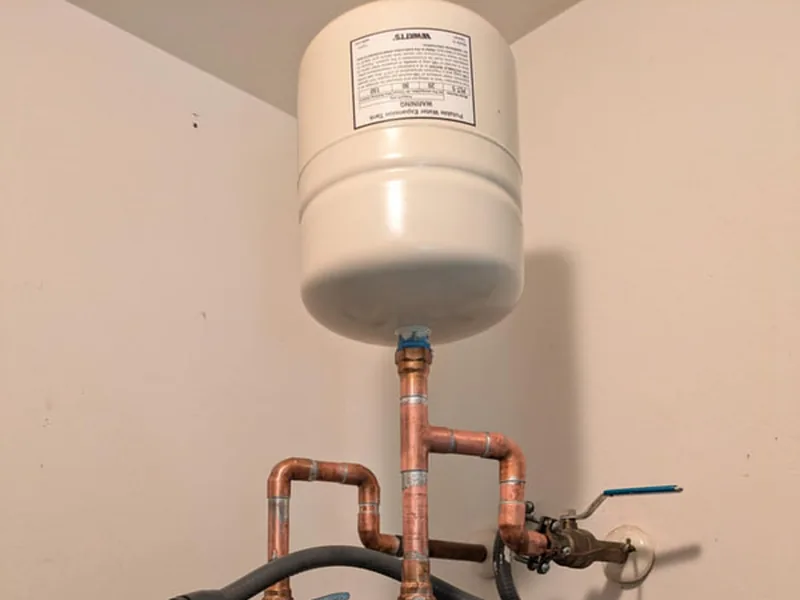
The expansion tank is the small tank hanging near your water heater that almost nobody thinks about — until it fails. It is a critical safety and longevity component, especially in DeSoto where many homes sit on closed-loop municipal water systems with check valves and pressure regulators. Without a working expansion tank, every heating cycle spikes pressure inside your tank, stressing seams, valves, and fittings. This guide explains what the tank does, how to tell when it is failing, and what to do about it.
What an Expansion Tank Does
When water heats, it expands. In an open plumbing system, that extra volume pushes back into the city main. But most modern DeSoto homes have backflow preventers, check valves, or pressure-reducing valves that create a 'closed' system — expanded water has nowhere to go. The expansion tank absorbs it: a rubber bladder inside the tank compresses, giving the extra volume somewhere safe to sit until fixtures open. The result is steady pressure instead of a spike every time the burner or elements fire.
Signs Your Expansion Tank Is Failing
- The temperature-pressure relief (TPR) valve drips or discharges. This is the classic symptom. With nowhere to expand, pressure climbs until the TPR valve — set around 150 PSI — weeps or pops to protect the tank.
- The tank feels heavy or waterlogged. A healthy expansion tank is light on the bottom half (air) and the top may be warm. If the whole tank feels heavy and sounds full when tapped, the bladder has ruptured and the tank is waterlogged.
- Pressure gauge spikes. Watch a gauge on the system during a heating cycle; if pressure climbs far above static pressure, the expansion tank is not doing its job.
- Banging pipes (water hammer) when fixtures shut off. A failed bladder removes the cushion that softens pressure waves.
- Rusty water or corrosion at the tank connection. Condensation and slow leaks at a corroded tank connection can follow bladder failure.
Quick test: tap the tank from top to bottom with a screwdriver handle. A good tank rings hollow at the bottom and sounds dull near the top. A fully dull tank is waterlogged and needs replacement. You can also press the air valve (Schrader valve) on the bottom briefly — if water comes out instead of air, the bladder is ruptured.
Why Expansion Tanks Fail in Texas Homes
The bladder inside flexes thousands of times a year, and Texas heat plus hard water minerals accelerate wear. Bladders also lose their pre-charge air over time — most need 40–60 PSI of air pre-charge matching the home's static water pressure. When pre-charge drops, the tank 'bottoms out' and behaves like a solid pipe, defeating its purpose. Most expansion tanks last five to eight years, roughly the span of one water heater cycle. If your DeSoto water heater is due for replacement, the expansion tank usually is too.
Replacement: What a Technician Does
Replacing an expansion tank takes under an hour: the technician shuts off water and relieves pressure, unthreads the old tank, checks the pre-charge on the new tank and adjusts it to match your home's static pressure (this step matters — a mischarged tank performs poorly), and installs it with proper thread sealant and support if needed. They should also verify the pressure regulator and test the TPR valve while on site. This is a natural add-on during any expansion tank installation or service visit.
Preventing Pressure Damage
Have the pre-charge checked annually — it is a five-minute test during any water heater maintenance visit. Keep household water pressure in the 40–60 PSI range, and never plug or cap a dripping TPR valve to 'stop' the leak; the drip is a symptom of pressure your system cannot relieve, and blocking it risks tank rupture.
Do Texas Homes Require Expansion Tanks?
In most Texas jurisdictions, plumbing code requires a thermal expansion device wherever a closed water system exists — which covers the majority of DeSoto homes with pressure regulators or check valves. Home inspectors routinely flag missing expansion tanks during sales, and insurance adjusters notice them after water damage claims. Sizing matters too: most residential heaters pair with a 2-gallon tank, but larger tanks or high-pressure systems may need a bigger one. An undersized or incorrectly charged tank performs little better than none at all, which is why replacement should always include matching the pre-charge to your home's actual static pressure. If your heater was installed years ago without an expansion tank, adding one is inexpensive protection against the pressure cycling that cracks tanks and blows out seals.
TPR valve dripping or pressure spikes in your DeSoto home? Call Water Heater Leak Repair Specialists at (833) 713-2101. We diagnose expansion tank failure fast, size and charge replacements correctly, and make sure your system pressure stays where it should.