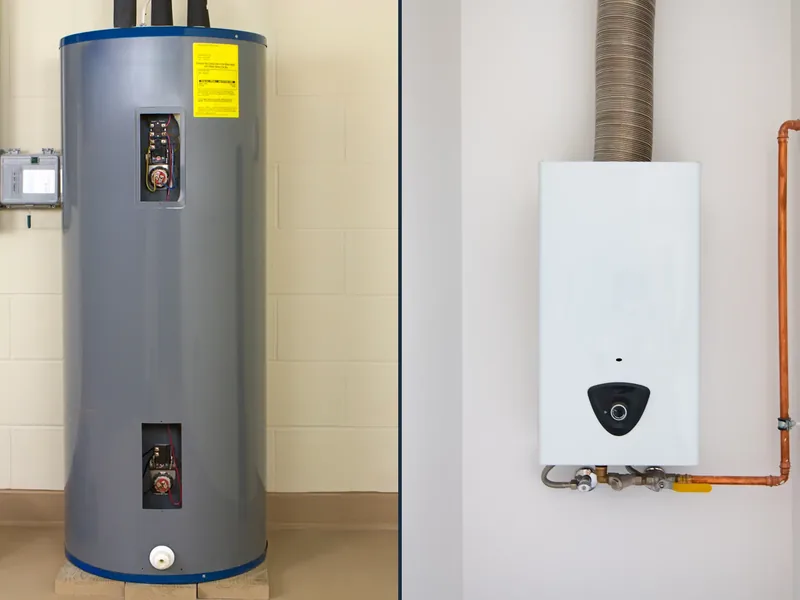
When DeSoto homeowners shop for a new water heater, one question comes up constantly: tank or tankless? Both have loyal fans, and both can leak — but they leak in very different ways, for different reasons, with different consequences. This honest comparison covers how each type fails, what repairs look like, and which is the better fit for a Texas home.
How Tank Heaters Leak
Conventional tank heaters store 40–50 gallons of hot water under pressure, so when they fail, they can fail big. The classic tank leak is corrosion through the steel tank wall — a pinhole at a seam or the tank bottom that grows until the tank weeps or ruptures. DeSoto's hard water accelerates this through sediment buildup and faster anode rod consumption. Tank leaks also come from fittings, the drain valve, and the TPR valve — all fixable. But a leaking tank body is not repairable: once the steel is breached, replacement is the only answer. The worst-case scenario, a ruptured tank, can dump the entire contents into your home in minutes.
How Tankless Heaters Leak
Tankless units heat water on demand through a heat exchanger, so there is no stored reservoir to burst. Their leaks are smaller in volume but trickier in nature: leaking water connections, failed internal gaskets and O-rings, a cracked heat exchanger (often from scale or freezing), or condensate drainage problems on high-efficiency condensing models. In hard-water areas like DeSoto, scale buildup inside the narrow heat exchanger passages is the number one enemy — it causes overheating, error codes, and eventually exchanger damage. Tankless leaks tend to be slow seeps rather than floods, but the repairs can be technically complex and parts can be expensive.
Side-by-Side Comparison
- Leak volume: Tank wins the worst-case contest — 50 gallons on your floor. Tankless leaks are typically drips and seeps.
- Leak causes: Tanks fail from corrosion and sediment; tankless fails from scale, gaskets, and freeze damage.
- Repair vs. replace: Tank fitting leaks are cheap fixes; a breached tank means full replacement. Tankless components are often repairable but parts and labor cost more.
- Maintenance burden: Tanks need annual flushing and anode rod checks. Tankless units need annual descaling flushes too — arguably more critical, since scale kills heat exchangers fast in Texas water.
- Lifespan: Tanks last 8–12 years here; tankless units last 15–20 with proper descaling.
- Upfront cost: Tankless costs two to three times more installed, including potential gas line and venting upgrades.
The Texas Hard-Water Factor
Here is the part that matters most for DeSoto: both types suffer in hard water, but in different ways. Tanks accumulate sediment at the bottom; tankless units accumulate scale inside precision passages. A tankless heater without a water softener or regular descaling in North Texas is asking for early heat-exchanger trouble. If you go tankless here, budget for a softener or commit to yearly descaling — skipping it voids many warranties. Our tankless water heater service in DeSoto sees the consequences of skipped descaling every month.
Which Should You Choose?
Choose a tank heater if you want the lowest upfront cost, simplest repairs, and easy parts availability — and you are willing to flush yearly. Choose tankless if you want endless hot water, higher efficiency, a longer lifespan, and a smaller footprint — and you commit to descaling and possibly softening your water. For leak risk specifically: tankless is the safer bet against catastrophic flooding, while tanks are cheaper to keep alive. Either way, a drain pan with a proper drain line under the unit is cheap insurance we recommend for every installation.
When to Call a Professional
Whether your tank is weeping at the seam or your tankless unit is throwing error codes and dripping, the diagnostic approach is the same: find the source, assess whether repair makes economic sense, and be honest about replacement timing. A good technician will not push the expensive option — they will show you the evidence.
Installation Realities in DeSoto Homes
Switching from tank to tankless is rarely a simple swap. Tankless units often need a larger gas line than the old tank heater used, plus new venting — many require stainless steel concentric venting rather than the existing flue. Condensing models need a condensate drain routed to a suitable discharge point. Electrically, some units need a dedicated outlet for their controls and freeze protection. These upgrades are normal and manageable, but they are part of the true installed cost, so get them itemized in any quote. Placement matters too: tankless units mounted on exterior walls need freeze protection rated for Texas cold snaps, and indoor units need combustion air just like any gas appliance. A proper water heater installation assessment in DeSoto covers gas sizing, venting, drainage, and freeze protection before you commit — the installs that go smoothly are the ones planned thoroughly.
Tank or tankless leaking in DeSoto? Call Water Heater Leak Repair Specialists at (833) 713-2101. We service both types, and we will give you a straight answer on repair versus replacement — whichever system you have.