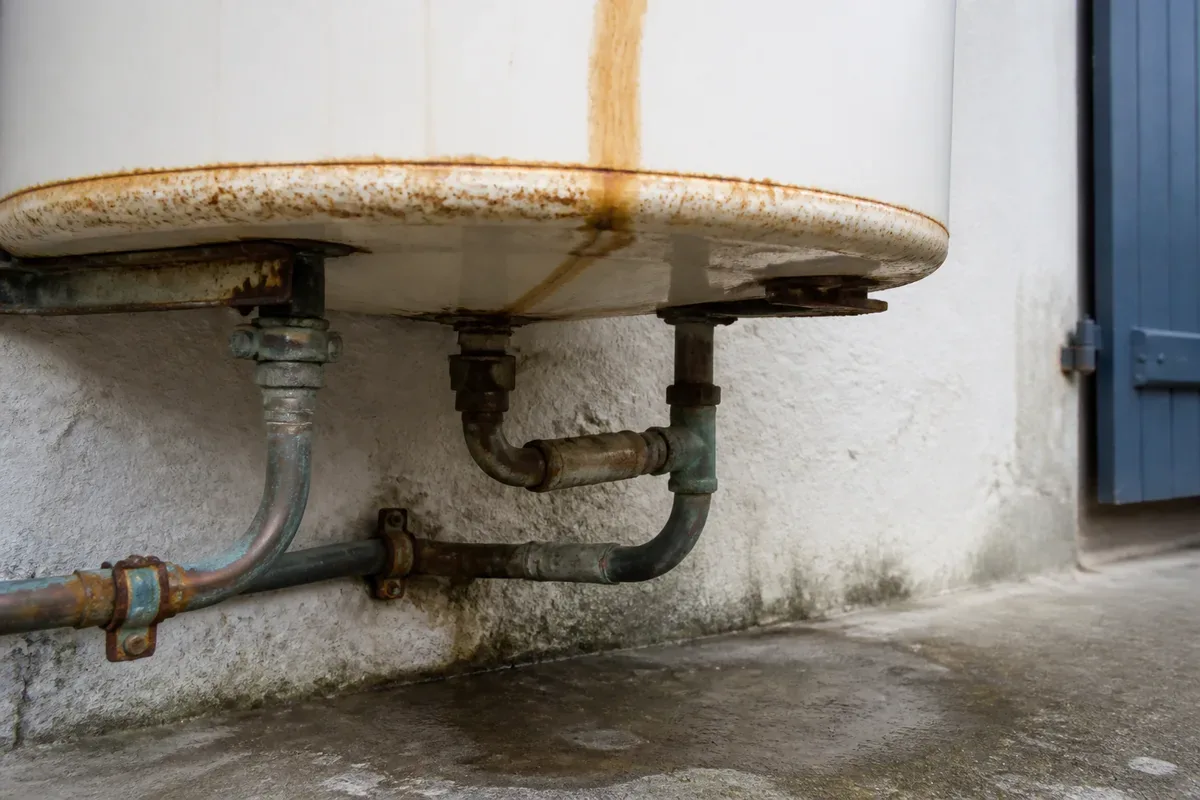
IN SHORT: Not every “tank leak” means the tank is dead. Water at the base can come from a loose fitting, a weeping relief valve, or a failed drain valve — all repairable. A rusted-through tank wall cannot be patched safely. We find the true source first, repair what is fixable, and tell you straight when replacement is the only safe option.
When a homeowner calls about a leaking water heater, the words they use are almost always tank leak. What they mean is water where water should not be: pooling at the base, staining the garage floor, dripping from somewhere underneath. But a puddle at the base of a heater is a symptom, not a diagnosis, and the actual source of that water decides whether you are looking at an affordable repair or a replacement.
Here is the distinction that matters: roughly half of what gets called a tank leak is not the tank at all. It is a fitting, a valve, or condensation, each fixable without replacing the unit. The other half is the tank wall or a weld seam giving way to rust, and that cannot be repaired safely at any price. This page maps the five places a so-called tank leak actually comes from, explains our on-site decision process, and covers the DeSoto factors that push tanks toward failure.
The Five Places a Tank Leak Actually Comes From
- Inlet and outlet nipples. The hot and cold connections on top of the tank live a hard life: constant temperature cycling, condensation dripping down from above, and dielectric unions joining dissimilar metals. They corrode, their threads weep, and water runs down the tank jacket and pools at the base, looking exactly like a tank failure. New nipples, fresh dielectric unions, and proper sealant fix it.
- The temperature-and-pressure relief valve. The T&P valve on the side of the tank is designed to discharge water when pressure or temperature exceeds safe limits. A dripping T&P is usually a symptom of excessive system pressure, thermal expansion in a closed system, or a failed expansion tank, and sometimes simply a worn-out valve. We diagnose the cause rather than just swapping parts.
- The drain valve. The spigot at the tank base weeps as its washer degrades or cracks when its plastic body goes brittle. Because it sits at the very bottom, its drips pool right where a tank-wall leak would pool. A full-port brass replacement solves it permanently.
- The anode port. Seepage around the anode rod's hex head on top of the tank can travel down the jacket. Resealing or replacing the anode addresses it.
- The tank wall or a weld seam. This is the real tank leak: rust-through from the inside, usually at the bottom where sediment holds moisture against the steel, or a seam that has split under years of pressure cycling. The steel is compromised across an area, not at a point, which is why it cannot be fixed.
There is also a common false alarm worth naming: condensation. A cold tank in a humid garage sweats, especially after heavy hot-water use refills it with cold water, and that sweat drips to the floor. We verify suspected condensation by drying the area and watching whether moisture returns without any pressure in the system, because replacing a heater over sweat is an expensive error.
Repairable vs. Replace: Our On-Site Decision Tree
On arrival we work a simple decision tree. First, we find the true source by drying the area and watching where water reappears, checking fittings top to bottom before concluding anything about the tank. If the source is a fitting, valve, or port, we quote the repair; these are typically completed the same visit from the parts we carry. If the source is the tank wall or a seam, we show you exactly what we found, explain why patching is not a safe option, and quote a replacement.
Age informs the recommendation but does not dictate it. A six-year-old heater with a leaking nipple gets a repair without hesitation. A fourteen-year-old heater with a weeping seam gets a replacement recommendation even if someone offered to patch it, because the rest of the tank is the same age as the part that failed. In the middle, we give you both numbers: the repair cost against the tank's realistic remaining life, so the decision is arithmetic, not pressure.
On the subject of patching, we are direct: a water heater tank is a pressurized vessel, and epoxy or weld patches over rust-thinned steel do not restore its structural integrity. A patched tank can let go without warning, releasing dozens of gallons at once. Any quote that offers to seal a tank-wall leak is selling a temporary illusion with real downside. We do not offer it.
How We Repair a Fitting-Level Leak, Step by Step
- Isolate and make safe. Heat source off, cold-water inlet closed, pressure relieved through a hot tap.
- Drain below the repair point. Top-fitting work needs only a partial drain-down; lower work needs more. We drain to a hose routed to a safe discharge point.
- Remove the failed fitting. Corroded nipples are unthreaded with proper wrenches and tank bracing; seized connections get penetrating oil and patience, not force that damages the tank port.
- Install new components. New steel or brass nipples, new dielectric unions where dissimilar metals meet, threads sealed with PTFE tape and pipe thread sealant rated for the application.
- Refill, purge, and pressure-test. Tank refilled completely, air bled from hot taps until flow runs solid, heat restored, and every touched joint checked under full operating pressure for any weep.
When the culprit is the T&P valve discharging for a real reason, the repair goes one level deeper: we check household water pressure with a gauge, test the expansion tank's air charge, and verify the thermostat setting. Fixing the pressure problem stops the discharge permanently; swapping only the valve does not.
The T&P Valve: When Discharge Is a Symptom, Not the Disease
The relief valve deserves its own section because it confuses more homeowners than any other part. Its job is to open at 150 PSI or 210 degrees, and when it drips, it is doing that job. The question is why the system is reaching those conditions. In DeSoto homes the usual answers are thermal expansion in a closed plumbing system, where a pressure-reducing valve or check valve traps expanding heated water with nowhere to go, or a waterlogged expansion tank whose air cushion has been absorbed. Municipal supply pressure running high makes everything worse.
The correct fix sequence is: measure the pressure, check the expansion tank, and only then decide about the valve itself. A valve that has been weeping for months may indeed need replacement by the end, but replaced alone it will start weeping again within weeks. We fix causes, not just symptoms, and we explain the pressure readings as we go so you can see the logic.
DeSoto Factors That Shorten Tank Life
DeSoto's water chemistry is the slow background force behind most tank failures we see. Dissolved minerals settle as sediment on the tank bottom, and that sediment layer does two kinds of damage: it insulates the steel from the water, so the bottom runs hotter than designed and stresses the metal and glass lining, and it holds corrosive moisture against the steel continuously. Tanks that never get flushed in hard-water cities simply do not reach their rated lifespan.
The local housing stock compounds it. Many DeSoto neighborhoods were built from the 1970s through the 1990s, and heaters in those homes are often on their second or third decade of service with original-era sediment baked in. Garage installations swing through big temperature cycles every summer, expanding and contracting fittings and seams. Hard freezes, the February 2021 event being the unforgettable example, shock already-weakened tanks and crack stressed fittings. And because DeSoto homes sit on slabs rather than basements, a slow tank-wall weep can run for weeks under a water heater with nobody noticing until the flooring at the room's edge starts to buckle. Knowing your shutoff valve locations before you need them is the cheapest insurance in this town.
What to Do Right Now If You See Water
Close the cold-water valve above the heater, switch the heater's heat source off, and call us. If water is spreading, thread a hose onto the drain valve and direct it outside or to a drain, and move anything valuable out of the water's path. Take photos for your records. Do not keep running a heater that is actively leaking from the tank body, and do not attempt to seal a tank-wall leak with store-bought products; they cannot make a compromised pressure vessel safe. Describe what you see when you call (833) 713-2101, and we will guide the immediate steps while dispatching a technician.
Is It the Tank or Just a Fitting? Find Out Before You Pay for a Replacement
Half of quote tank leaks unquote are repairable fitting and valve problems. Water Heater Leak Repair Specialists finds the true source first and gives you an honest repair-or-replace answer. DeSoto, TX — call (833) 713-2101 today.